How We Moved to Italy pt. 2 | Codice Fiscale, Permesso di Soggiorno, and Apartment Hunting
In the Spring of 2025, my boyfriend (Tyson) and I moved to southern Italy on one-year Youth Mobility (Working Holiday) visas. After our visas were approved, we packed up our lives into one checked bag and a carry-on each, before we caught our flight to Italy.
In this post I’ll cover the admin and logistics side of what happens after arriving as we began to settle into life abroad — everything from setting up phone plans to applying for the infamous permesso di soggiorno (PdS).
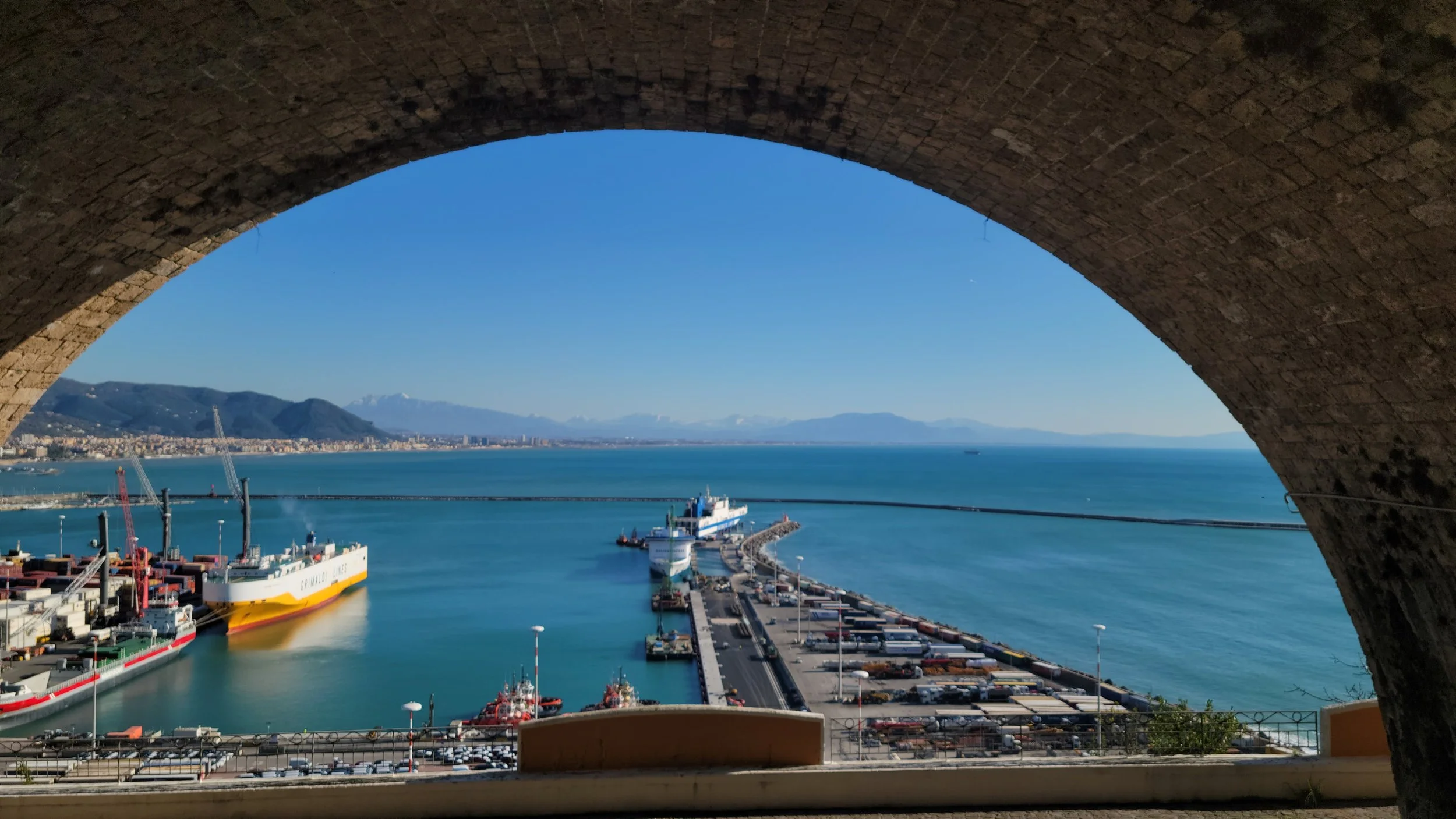
The view from our front step
→ If you want the full visa application process, check out part 1!
Step One: navigating public transportation from Rome to Salerno
We flew from Toronto to Rome, and headed straight down to Salerno where we would be basing ourselves. We caught the Leonardo Express from Leonardo da Vinci International Airport (FCO) to Roma Termini and then booked our tickets down to Salerno, eager to settle in and relax as soon as possible.
First thing to navigate was purchasing tickets, confirming validation (the most important step), and catching our train while battling the exhaustion of an already long travel day.
After arriving in Salerno it was time to figure out the bus system — I will almost never pay for a taxi or driver if I don’t have to! So we stopped into a tabacchi to grab biglietti (tickets), then travelled across town to our accommodations for month one.
Step Two: setting up phone plans
For some reason we put this off until almost the end of month one, but speaking with hindsight, I’d set them up sooner rather than later. It will make your life so much easier with everything from package deliveries to your permesso di soggiorno application.
Compared to Canada, phone plans are so reasonable here. We went with Iliad — €9.99/month for 250GB of data — and apart from the occasionally spotty service, have been very happy with it. We stopped into the Iliad store, and walked out will activated e-sims 15 minutes later.
You will need to provide ID (passport) and an address (temporary is fine). Technically, they also require a codice fiscale (Step 5), some providers will let you set it up without one.
Step Three: before you apply for the permesso di soggiorno
Alright, time to get down to the heavy stuff.
Let me start by saying that when talking to people in other regions, it seems that the process varies a lot, despite there being very clear instructions on the Italian Consulate website. This process reflects only what we experienced in Salerno when applying for our permesso on a Youth Mobility (Vacanze Lavoro) visa in 2025.
What to know before you apply/arrive:
Where you apply matters. Your residency will only be approved for the region you apply in. So if you land in Rome and apply there, only to decide you want to move to a different region, it will cause problems down the road and you will have to restart the process.
Pick up your kit from the post office. You’ll need to get one of these applications at the post office and fill it out completely in order to submit. You need the envelope marked with a yellow stripe on the side.
You need to submit the application within eight days of arriving in Italy. We were told by the worker at the post office that it was eight business days, not calendar days, but I’ve seen varying information as to whether or not that’s true. I would suggest erring on the side of caution and get it submitted ASAP just incase!
Step Four: filling out and submitting your application
Filling out the application is confusing and stressful — if you cry during the process you are not alone! I’ve linked a document that fully breaks down how we filled out our kit.
The biggest stressor at this stage was that no one seemed to have any definitive answers for our questions and they would often contradict information we already had when they did. If this feels relatable, I promise you, life in Italy does get better! It’s all worth it in the end.
Actually submitting was a run-around too, and this is where I’ve found people’s experiences vary the most with this visa specifically.
What you need to have when submitting your application:
your passport — and photocopies of the ID page, visa page and entry stamp page to mail in with the kit
4 passport-size photos — we got extra copies when applying for our visas
€16 marca da bolla — a tax stamp which can be purchased at a tabacchi
proof of accommodation — Airbnb has a “get a PDF for visa purposes” option under your booking details, include a printed copy of that or something similar
proof of health insurance coverage — print out the policy document for this
codice fiscale — if you have it already… if not, we didn’t and had no issues
your permesso kit — filled out completely and correctly
payment method — you will have to pay the application fees (Bollettino Poste Italiane, a white slip with red stripe included in your kit), card is accepted
According to the Italian Consulate website, applications for the Youth Mobility (Vacanze Lavoro) visa are supposed to be submitted directly to the Questura (the police headquarters/local immigration office) — information I have since verified on the Polizia di Stato website — but when we showed up, they told us it was wrong and we had to submit through the post office instead.
The post office gave us receipts with a date, time and extra information for our biometrics appointment. Carry this receipt and your passport around with you until you receive your actual PdS — these items prove you are allowed to be in the country in the meantime. For us, the waiting period before the appointment was eight months.
Step Five: get a codice fiscale
The codice fiscale is your tax code, and it shows up everywhere! Your rental lease, your phone plan, your permesso, finding employment, banking — all of these and more will ask for your codice fiscale and it’s easier to have it ready to go before you suddenly need it.
For full transparency, we set ours up after our PdS application submission, but we did need it when signing the papers for our long-term rental. I would recommend doing it as soon as you can so you don’t run into any issues though.
To schedule an appointment and find an office near you, visit the Agenzia delle Entrate site. Our appointment only took about 30 minutes and we left with our codice fiscale in hand.
Step Six: finding a place to call home
We wanted to be able to view a place before signing anything, so we decided to book an Airbnb for the first month we were living in Salerno and start looking for a place once we arrived and acclimatized to life in Italy a little.
In the end, I think we got really lucky with not only the ease with which we found a home, but our landlord being so wonderful. I’ve heard some horror stories.
We looked at some places posted on Facebook Marketplace, but ended up going with one that we found in the next town over (Vietri sul Mare) posted on Idealista through a real estate agent.
A few things to keep in mind when you’re looking for a home:
Unlike in Canada, real estate agents also get paid by the tenant, not just the owner. Don’t forget to ask about their fees and factor that into your budget (RIP to the €900 euros we didn’t know we had to pay).
A lot of places in Italy do not include basic kitchen appliances. In those cases, you will need to provide your own fridge, stove, etc. We only looked at fully furnished options and confirmed that everything (including plates and cutlery) would be provided.
AC/Heating and washing machines are not guaranteed. This was another thing we were adamant about. Our Canadian blood would have died in the southern Italian summer heat without AC.
Verify that your landlord registers your rental contract with the Agenzia delle Entrate. It’s really not on you, but if they don’t it could cause issues when you go to your PdS appointment.
Give your self tons of time. As with everything in Italy, nothing is quick. We requested a viewing, got one for a week later, an appointment a week after that, and finally signed the lease and received the keys a week after that — and that was with me being really persistent about getting things moving so we didn’t end up homeless while we waited!
To help with our hunt we also offered to pay way more than usual upfront. Seeing as we weren’t actively working when we were trying to find a home, we knew that offering up extra months of rent as a guarantee would increase our odds of finding something quickly. If you are financially able, consider doing the same!
FAQs:
Q: Can you leave Italy while you’re waiting to receive your permesso di soggiorno?
A: In our experience, during our first application, we were able to travel around Europe. We flew home to Canada and visited Croatia, the Netherlands, Spain, England, Portugal and more with no issues at the border. However, if you are renewing and your old permesso expires before the new one is issued, you cannot leave the country until you receive the replacement card. In some situations you are able to fly direct to your home country during the waiting period. Always double check with official sources before booking anything!
Q: Do you need to fill out both booklets in the permesso application kit?
A: The second booklet is only for those who are working at the time of application, since the visa we were on did not require a work contract, we did not fill it out, and omitted it from the application.
Q: How much do you have to pay for the Bollettino Poste Italiane (postal order which is a white slip with red stripe across the top)?
A: For the Youth Mobility (Vacanze Lavoro) visa we paid €70.46 which covered the one-year residence permit fee plus the post office’s electronic submission fee. Hold on to your receipt/copy and double check what you’re paying for so you don’t accidentally pay twice.
